Polar Hype (Part2): Behold the Parasocial Antimedia ☢
Recent excitement over the European-based social media ‘W’ appears to be adding to the long list of new platforms offering variations on the same thing: collective real-time consumption and sharing of content – an extremely popular (social) activity that provokes revolutions, changes lives, generates revenue, fun, and relations, which is fundamentally what humans always did and enjoyed doing. However, for the last 30 years or so, online-based social media of all sorts have taken pride in claiming to be something new that people want globally and need to do incessantly. Surprisingly, it is all quite true. Social media are popular, and people seem to want them. Unfortunately, this tends to be for the worse reasons.
This short blog explores the relationship between ‘polarity of hype’ and social (mass) media. While much of the existing literature focuses on virality, political (mis)communication, or platform algorithms, I argue that hype is not merely a by-product of social media or a central mechanism by which it operates. Still, it is intrinsic to the very access to its content and conceptualisations, borrowing from philosopher Paul Virilio’s term of ‘polar inertia’, slightly twisting the phrasing into a form of polar (peak) hype.
If, as I argued in the previous post, smartphones have become the ultimate hype sustaining tools, social media platforms have perfected the art of capturing and sustaining attention – and have done so since their first conceptions – perhaps, if one is to think of it, unsurprisingly: the desire to participate, connect, and remain visible is embedded within networked communication of civilisations.
This raises an interesting question. Social media are not only the quintessential product and consumption of hype, but they also always generate and sustain hype – they’ve always been popular and demand more popularity. Yet, why did some platforms succeed while others disappeared? MySpace's huge popularity was rapidly eclipsed by Facebook, much as the iPhone displaced BlackBerry. Was it just a shift in hype?
The appeal of social media long predates Facebook, MySpace, or even the ‘WWW’ itself, central to danah boyd’s analysis of allowing users across the world to feel ‘being part of something’. Just think of the early 1980s excitement surrounding The Whole Earth Catalog (favoured by Steve Jobs) and its digital offshoot, the WELL (Whole Earth 'Lectronic Link). Tech-guru Howard Rheingold famously defined the WELL as a 'virtual community', hilariously describing it as: “like having the corner bar, complete with old buddies and delightful newcomers and new tools waiting to take home and fresh graffiti and letters, except instead of putting on my coat, shutting down the computer, and walking down to the corner, I just invoke my telecom program and there they are. It's a place.”
These ‘placehood’ dynamics became institutionalised with the launch of SixDegrees in 1997, one of the first platforms to permit the public display and personalisation of personal profiles, visible friendship networks, and online communication. Although relatively short-lived, SixDegrees established the basic architecture that would define subsequent social networking sites.
SixDegrees introduced many of the features that would later become standard across social networking platforms, including personal profiles, visible friendship networks, and online communication. Although it attracted approximately 3.5 million users before closing in 2000, its significance lay less in its commercial success than in its role in establishing the basic architecture of social networking.
Throughout the early 2000s, platforms such as Friendster (115 million users), Bebo (40 million users), and Orkut (100–115 million users) expanded this model globally. Together, they helped transform the web, providing a recurring pattern for users of ‘free profile pages where they list their vitals, favourite quotations, hobbies, previous jobs and future career interests’… Sounds familiar?
Thus, long before content-tailoring algorithms, eye-glueing smartphones, and click-baiting influencers, digital communities were already part of the hype machine, generating excitement, attachment, and collective participation with astonishing numbers. What changed over time was not the existence of hype, but the technologies through which it could be amplified and sustained the hype itself, one social media after the other.
And if they all offered more or less the same thing, what made Facebook – and the following social media reach +billion-user mark?
Journalist Julia Angwin suggested back in 2009 that Facebook's rise was not necessarily the result of a radically different social experience. Rather, it benefited from broader technological developments that were reshaping online interaction. Much as the iPhone did not invent the mobile phone but came to embody a new multi-tasking technological achievement, Facebook emerged at a time when digital photography was becoming increasingly widespread and accessible. The platform was therefore able to integrate itself into a growing culture of visual self-presentation and image sharing that earlier social networking sites had struggled to accommodate.
Yet despite their remarkable popularity, these early social networks remained relatively text-oriented. While users could create profiles and upload photographs, participation was still constrained by the technological realities of the period. Compared with the image-saturated social media environments that would emerge in the following decade, online interaction was slower, more static, and less visually intensive.
One of the less appreciated limitations facing early social networking was the absence of widespread digital photography. As SixDegrees founder Andrew Weinreich later recalled, the company even considered having users physically mail photographs for scanning and upload. It was only with the growing availability of digital cameras, camera phones, and later smartphones that social networking became increasingly organised around the production, circulation, and consumption of images.
Facebook benefited not merely from better design, but from emerging at a particular moment in the co-development of social practices and digital technologies. SixDegrees appeared before digital photography had become widespread, limiting the extent to which users could visually represent themselves online. Yet the demand for online sociality, self-expression, and sharing was already evident. As digital cameras, camera phones, and image-processing capabilities became more affordable and commonplace, they both responded to and further stimulated these emerging practices. Facebook arrived precisely at this intersection, integrating itself into an expanding culture of visual self-presentation and image sharing that was already taking shape while simultaneously accelerating it. Features such as the effortless uploading, compression, and circulation of photographs transformed images from cumbersome digital files into everyday social objects. In this sense, hype preceded Facebook, but Facebook became one of the principal infrastructures through which that hype was organised, intensified, and monetised.
Thus, from the totalising acquisitions of Instagram and WhatsApp, Facebook expanded with visuals, messaging, and relational features; users increasingly related not simply to one another through the platform, but to the platform itself.
The result was the emergence of what might be called a "one profile to rule them all" model. A single digital identity became the gateway to an increasingly broad range of social interactions, relationships, and performances – culminating in Mark Zuckerberg’s 2010 statement that having multiple identities was a sign of lack of integrity - when he wanted to “tackle” misinformation by people who had many “fake” profiles, thus killing off all good stuff about performativity of the self online. As journalist Marie le Conte discussed, Facebook transformed the presentation of the self into a continuous, networked, and highly visible process embedded within a ‘public’ everyday life from which there was no escape, no back door, no, as Turkle argues, ‘second self’.
Together, they created a social environment organised around a singular and persistent profile, the curation of it, perpetual access and constant stream of content: a public self that could be searched, viewed, tagged, liked, and, more importantly, continuously updated – and ever more importantly (if possible be) judged ad-libitum a pattern that has become central also within the global south, with platforms such as Weixin (WeChat) and Beibo: if you are not connected, you do not exist. AKA: if there’s no pic, it didn’t happen.
Yet this "one and only" digital self is inherently problematic, with a ‘profile’ that presents itself as an authentic representation and the very existence of the individual while simultaneously functioning as a carefully curated and mediated construction, as memetised by Dolly Parton in 2020:
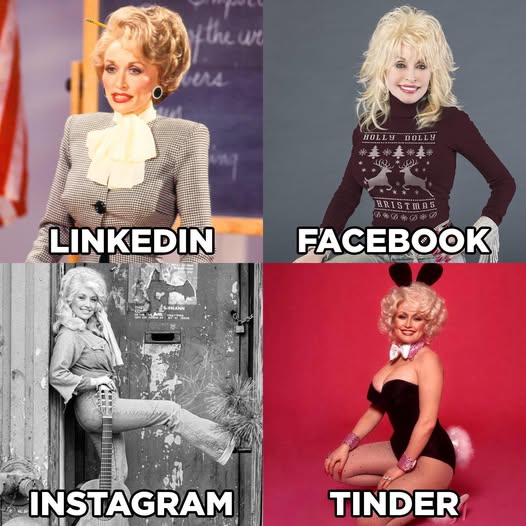
This leads to the extent of integrating so-called social credit surveillance assemblages and rating mechanisms that increasingly resemble Black Mirror-esque conditions, which Musk’s X has proven to very much aspire to. What appears to be self-expression is often a selective performance of the self, continuously managed before potentially limitless audiences, requiring polar hype of curation, attention, and interaction: a frantic standstill of perpetual engagement to which opting out is a no-go.
As Geert Lovink argues, within this condition, users increasingly find themselves "stuck on the platform", caught within systems designed to maximise participation while offering diminishing social rewards. Endless scrolling, continuous exposure, and the pressure to remain visible transform social media into an environment of perpetual connectivity without necessarily producing meaningful connection in what over the years criminologists and social theorists alike defined as ‘Anti-Social Media’ – and which are, with advancing hyped tech such as VR Headsets and the like, only progressing into a further abusive, toxic environment of harassments, bullying and conspiracy (particularly associated with hype and perhaps worth another blog in itself…) and/or consumeristic meta frontiers of ‘hyperconnections’.
Such are the arguments around the mediatic appropriation of the ‘Mirror World’, as conceived in her last work by Naomi Klein: A condition where reality and its distortion may develop at the same time, and distortion becomes a much more entertaining, interesting, and in many ways overhyped establishment. This is what danah boyd, more recently and somewhat apologetically, describes as Parasocial media – with a pinch of nostalgia over the “essence’ of social media having “changed”.
If Facebook became inseparable from the smartphone ecosystem, the reverse is equally true. Smartphones—and particularly the iPhone, their most influential embodiment—became the devices through which social media's promise of perpetual connectivity, visibility, and participation could be fully realised—the one could not do without the other. By this, the exciting features of Snapchat and TikTok appear strictly correlated. They emerged to fill the void left by the smart device: perpetually in one ‘hand’, they perpetually ‘demand’, and by this requiring further interaction, likes, visibility, clicks, and shares. The ageless performance began arguably first with the selfie stick, and thus with the virality of TikTokers tiktoking themselves on the street, group-dancing to the algorithmic vibe of the past centuries’ Black Death Dancing Manias.

Thus, in this increasing, endless excitement to which ‘refusal’ and ‘resistance’ only seem to raise further FOMO contrasted to inefficient ‘social media bans’, what exactly are social scientists nostalgic for? Is it rather a FOBO – a Fear of Better Options?
The more users the internet allowed, and the more their data could be monetised, social media always found its hyped excitement and astonishing support from the media, intellectuals, and users themselves, only to be self-deluded and failed due to technology, structure, the capitalist values surrounding it or the ugly people joining it. The utopian reality of the WELL, described by Rheingold, and the enthusiasm for the development of the self through computers in Turkle's earlier writings clearly show the rhetorical degeneration and loss of control over communication engines.
The question, then, is not whether we should be nostalgic for the social media we used to have – which fundamentally has been and remains a product of a polarity of hype. Rather, it is whether we begin demanding the social media we actually want, cutting through the ‘hype’.
Thus, what we might aspire to, again, is to cut through the hype by creating a condition in which we're not fundamentally embedded within self-evident, toxic devices and self-evident hooking and dependency-leading dynamics that emulate reality, but rather in dissolute concreteness and sociality. This is not simply a boycott of social media itself—creating a surreal condition in which anyone who does not actually use certain (incompatible) social media struggles to be communicated with—but an attempt to recreate a dynamic of interaction with social media that does not allow the perpetual induction of hype and the polarity of these circumstances.
This is, for example, evident in the apparent total uselessness of banning social media for adolescents and children across Anglo-Saxon countries, while their very parents and teachers remain fully addicted and embedded in it. It is here that we should seriously rethink, as philosopher Byung-Chul Han has long and insistently argued: What are the current means to truly ‘share’ a conversation in a communal, meaningful way, to tell each other who we are and what we can do together, perhaps not in an instantaneous, porously gratifying way – but in a binding and enduring manner?
These questions may certainly be behind the current ‘unhype’ trends, especially among Gen Z, to promote ‘Switch Off’ Events and ‘staring at walls’, which reads perhaps a little like the great return of the ‘mindfulness’ and digital detox trends, which are certainly commendable but just as much hyped. So perhaps why don’t we start by raising our eyes from this very screen, nod to a friend, colleague or even a total stranger, and talk.