Polar Hype (Part 1): Big Bad Smartphone
Polar Hype (Part 1): Big Bad Smartphone
Janos Mark Szakolczai
University of Glasgow
Last month’s headlines have cast allegations against Meta Platforms and Google as a long-awaited ‘Big Tobacco’ moment for Big Tech – a moral reckoning over years of prioritising profit over children’s well-being. While the juries’ decisions are certainly valid and significant, it is also important to consider whether the current wave of glee can itself be read as hype, given that the legal process is very much still unsettled, multi-corporate appeals are already underway, and any definitive resolution is likely to take years.
As Meta representatives announced, “Teen mental health is profoundly complex and cannot be linked to a single app”, and this is astonishingly true – and sadly, their best means of defence over the last decades.
Framing the issue solely in terms of a single corporate failure or misconduct towards children, parents, users, investors and markets obscures attention from the actual scary, smart, charged tools and systems that make such harmful dynamics possible in the first place. During similar ‘Big Tech Bad’ social awareness moments, such as the decade following the ‘Cambridge Analytica’ scandal, public attention briefly turns to questions of accountability, particularly given the scale of these companies’ vicious influence and malignant profitability. Documentaries such as ‘The Social Dilemma’ and ‘Molly Vs The Machine’ exemplify this, making people all across the web feel bad and indeed charged-up their clicktivism intake–yet scrutiny tends to dissipate quickly, diffused across complex infrastructures and weakening attachment to any single object of critique (is this blog still relevant?).
The problem with all that is that each time we raise a fist in response to corporate abuse, we tend to do so while also grasping in it a smartphone – and this is where I argue the problem lies.
Indeed, there is a longer history of co-development between competing firms such as Facebook and Apple, forming an integrated platform ecosystem in which infrastructure, devices, and applications evolve together, thereby replicating instances of harm. At the centre of this configuration, I argue in this post, is the smartphone, a device that operates not merely as a platform but as a central apparatus that drives and organises the production of hype, with its endless pitching, scrolling, and sharing, and its eye-catching, content-craving design that, per se, embeds the permanency of hype in the market, the investor, the user, the parent, the child.
As early as the 2000s, French cultural theorist Paul Virilio proposed the idea of ‘polar inertia’ to describe how increasing speed and connectivity paradoxically produce a form of stasis, with the user remaining physically still while constantly engaged through screens and networks. Polar inertia can be understood as a core feature of this socially accelerated hype dynamic, a systematic ‘frenetic standstill’ (in the words of Hartmut Rosa), which we may further interpret as a ‘polar hype’, expanding our understanding of what these devices enable and require, as they repeatedly pull the user back into the very space, into a hypered binge-intensive screen-time.
I use this parable to outline what I call ‘polar hype’ and how it is embedded in hyperconnected ecologies and wearable systems that accompany and extend it – a process that began with the smartphone (particularly, the iPhone) and now extends to all wearables. By "polar hype," I mean the way these devices reproduce a continuous, structured, and harmful renewal of attention that is not incidental but built in, creating a ‘standstill motion’ of perpetual hype. In this first part, I examine the harmful and ‘hypeful’ features of the smartphone–along with its likely future directions–as a system that organises interaction into a perpetually heightened state, marked by recurring and systematic patterns inseparable from its design logic. In Part 2, I extend this discussion to social media, considering how these same harmful and ‘hypeful’ dynamics are amplified and operationalised within networked platforms.
2026: A Hype Odyssey
There are many smartphones, and they are all quite alike. Among them, arguably, the definitive smartphone is the iPhone, central to the ‘one device’ narrative articulated by Brian Merchant. The iPhone has been the subject of sustained hype since its initial proposal and early interactions (similar to the successful hype around social media intake, as will be analysed in Part 2 of this piece).
It is difficult to ignore the visual and symbolic resonance between contemporary devices and the Monolith in ‘2001: A Space Odyssey’. The film's director, Stanley Kubrick, depicted the sudden appearance of a flat, opaque slab among primordial cave-crawling creatures, who all stare at it in awe and confusion. It is unclear what the tool does, other than giving them the sudden sense that the other tools they had been holding so far (err, bones) suddenly appear useless and somewhat meaningless.
The iPhone has long been coveted by users since the first images surfaced of this sleek, black glass device that, in many ways, has completely outshone older competitors, such as the BlackBerry. As I have discussed elsewhere, the Apple iPhone’s full-screen and sleek interface displaced the tactile appeal of physical keyboards, rendering devices from Nokia and Motorola comparatively toy-like – closer to sophisticated Game Boys than to instruments of work. Just like the bones in Kubrick’s depiction, the Monolith redefined both the aesthetic and economic baselines of the ‘serious’ device, establishing new expectations for what work-oriented technology should look like and how much it should cost (a damn lot).
The flat, lucid, and highly pervasive design effectively sets aside all other superficial tools in the hands of the cave-like creatures, focusing on that specific ‘awesome’ and alien slab that is, according to the original short story by A.C. Clarke, a ‘Sentinel’ capable of communicating, once discovered, to an alien civilisation, the success of human progress – thanks to the original ‘contact’, shifting, in a single frame, from dawn of humanity to the space area. This might have been the hyped vision of Steve Jobs’ device. But what counts as evidence of such progress of this ‘contact’?
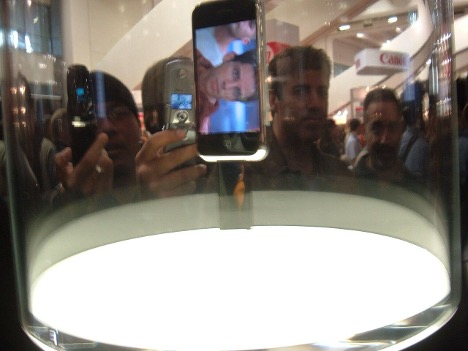
Be it at work and/or on the toilet, the UX design and operating systems of Android and Apple devices actively encourage – and, in many cases, structurally depend on – frequent, repetitive, recurring, impulsive engagement. Users are drawn into cycles of checking, lifting, scrolling, and re-engaging that border on the obsessive-compulsive, reinforced by high-density, ‘eye-glueing’ refresh rates and high-definition displays. This is evident in Apple’s Liquid Retina, as well as in more recent visual paradigms such as ‘glass-morphism’, visible in interface layers like the new iOS. The much-criticised ‘liquid glass’ aesthetic, with its opacity and flaws, ironically echoes Zygmunt Bauman’s account of liquidity in modern life, where boundaries dissolve, and social forms become unstable, “leaking” into everyday interaction.
What Michel Serres once triumphantly described as thumb-centric interaction with his fabled ‘Thumbelina’ parable (i.e. capable of communicating with their thumbs), is now characterised by a body-led device-bound series of gestures distributed in a repetitive choreography of chores: microgestures across screens, platforms, and contexts that extend beyond any single hyperconnected interface, tapping phones, scrolling watches, pinching earphones, waving at cameras, typing all things solid into mid-air…
Hype-time
The ‘frenetic standstill’ of smartphones now operates in conjunction with wearable and sensor technologies, from always-on watches to fitness-tracking rings to AR Glasses. Even if we do not venture far beyond arm’s length, and our fingers may even be replaced by next-gen neural reflexes, as with the ‘on-wrist’ control of Meta and the likes, we remain physically limited – no matter where our minds are carried. Yet these movements are by no means a form of inertia; it is not a now-and-then, all at the same hypered-space and ‘screen’-time. Rather, within this intensified “screen/time” of spatial limitation, what emerges is less a novel mode of interaction than an extension of already established patterns: repetitive, time-flattened, and often compulsive scrolling engagement characteristic of smartphone and social media use becomes more pervasive, more palpable, and correspondingly harder to interrupt as interfaces and platforms are more deeply integrated and expressed into everyday routines of an effective ‘hype-time’.
It is somewhat hilarious that the early iPhone ads showcased the device’s funky features, only to be interrupted by a full-screen phone call – the message being ‘hey, it also takes calls!’ – but also perhaps inadvertently frowning upon it – “oh gosh, how’s calling me?” A feature that Apple tackled in two successful ways to maintain its ‘polar-hype time’. Firstly, since iOS 14 (2020), the option for smaller banners (not full-screen) has allowed users to decline a call without covering the entire content of their screen. Secondly, a further feature update (2021) permitted tailoring the ‘focus’ status of the devices themselves (since iOS 15), setting unclear boundaries around ‘do-not-disturb’ modes and ‘sleep’ profiles, which seem designed to limit users’ engagement but ultimately justify uninterrupted screen- and time-binging, free from socialising distractions.
The true meaninglessness of the Do Not Disturb feature, which is by no means a de-hyping feature, is evident, for example, in its strict inability to limit or prevent notifications of Software Updates and other invasive features; while filtering otherwise important communication and yet allowing users to respond to trivial matters anyway, at any time… to which, it might be more fruitful to switch to a more open OS and install a minimalist and distraction free software (including turning off all notifications; going greyscale and set hard timers).
Indeed, it is perhaps no coincidence that both of these lazy IOS features (call banner & focus modes) appeared in the middle of the COVID-19 pandemic. The above-mentioned Liquid Eye-Glueing trajectory of device interaction was sharply articulated during the COVID-19 pandemic, when Naomi Klein’s critique of the ‘Screen New Deal’ identified how such crisis conditions of social and domestic isolation were leveraged to normalise an expanded regime of digital dependency, promoted by both policymakers and technology corporations. Under lockdown, users were positioned within an increasingly totalising media environment, in which endless work, communication, consumption, and entertainment converged into a continuous stream of mediated activity, confirming Virilio’s discussion of “domestic” variation of the polarity of inertia (‘domestic inertia’), whereas a form of ‘comatose’ physical immobility (“in which relations with the outside world are lost" p.68) coinciding with intensified exposure to both entertainment and harmful or affectively taxing content, and may have
Seen in this light, it is not surprising that users responded to the recent trials with both excitement and systematic backlash. Companies such as Meta Platforms have actively sought to extend and embed the modes of interaction that made the iPhone and social media so compelling – intensive, habitual, and are now investing in increasingly wearable (via bands, glasses, and even contacts) and potentially embodied (ingestibles, implants) technologies, which only open new horizons of what hype intake, and harm-abundance, they may allow.
Hype®invisibility
If there’s still some marketable satisfaction in the fact that iPhones have been among the most enduring pieces of technology, sustaining the market for at least 20 years now (though the ongoing yet another hyped leadership transition might tell a different story), there is an evident tendency for these devices to be turned from wearables into embedded AR-enhancing objects, aided by always-on AI features and turbo-charged sensors, and, as such, camouflaged as everyday accessories (and thus invisible, and by invisible, it's not even clear what they are actually doing – as with the hidden communication features among Apple devices via Near Field Communication (NFC) chips and ‘hands-off’ AirDrop features) – who will afford them, and who will not, what will they pay them with (spoiler: our data).
From this perspective, the progressive invisibility of these systems is likely to intensify rather than diminish engagement – thereby extending indefinitely the harmful dynamics they are already deeply involved in. I anticipate this under polar hype conditions, with interfaces receding and devices becoming less perceptible, thereby generating an additional layer of anticipatory attention and covert harms: already today, wireless accessories, such as AirPods, introduce convenience by removing physical constraints, while simultaneously producing a low-level, ongoing, and perpetual sense of attentiveness to a hyped state of anxious vigilance. Users are required to track not only their functionality but also their very presence: Yes, Bluetooth tech liberated us from ‘wires’ and cables, but just as well, the technologies replacing them can be just as easily displaced and, consequently, cognitively demanding, turbo-consumable goods. Not only by being yet another tool we need to connect, charge, keep (relatively) dry, but even worry, given their miniscule weight contrasted to the significant pricing, perpetually their whereabouts, whether they are supercomfy (always on in my ear?), misplaced in a pocket (are they in the washing machine?), or inadvertently mis-paired during a night out (modern-day first-world tragedy) – forgetting, along the way, their socio-economic and environmental impact.
Attention, as such, is no longer directed solely toward what devices enable, but toward ensuring their continuity – monitoring, locating, preserving, charging, and pairing. In this sense, invisibility of cables, movements and physical ‘tactile elements’ (say, touching the screen) does not eliminate engagement; it redistributes it into a more ubiquitous, anxiety-laden form, where the possibility of loss itself becomes a structuring condition of use, demanding, from its invisibility, our constant attention.
Memorybot
With devices always online, always on us, and constantly among us – at lunch, with family, on holiday, and even in the very images we produce and share - they sustain a form of intensified intimacy. They are with us, and They Are Here. We squeeze them into moments of solitude, distraction, and danger interchangeably. They isolate and expose us endlessly. Indeed, the ‘perpetual availability’ of smart devices can be read through the Korean-German thinker Byung-Chul Han’s notion of the digital ‘non-thing’: something that does not fully appear as an object yet maintains a persistent hold on attention. This condition extends into what departs from Erving Goffman’s account of social presentation. Rather than a managed ‘self’, social media increasingly circulates a ‘non-self’ – curated, idealised, and often unattainable profiles that demand continual checking, driven in part by the logic of Fear of Missing Out.
While doing so, applications such as Google Photos and Apple Photos actively prompt users to view, remember, and interact with past moments, using metadata algorithmic indexing and AI-driven curation to reintroduce images, metadata, and associations. In doing so, they reanimate prior instances of “screen-time,” encouraging their recirculation – often detached from their original context – through prompts to revisit, share, or reframe them, fostering a perpetual hauntology of building up pointless yet cooing and soothing uber-filtered memories: a true requiem for a lost memory, an intensive dream that will soon be replaced by another tool, another memory, another hype. The iPhone and its associates may soon be replaced by other tools, be they glasses or chips, but their structural harms and platforms will linger, as we will further discuss, focusing on the uber-hyped and yet parasocial characteristics of current media.
See you on the other side
In conclusion, this two-part series takes current accusations against firms such as Meta Platforms and Google as its point of departure but reworks them through the concept of ‘polar hype’ to shift the level of analysis from corporate conduct to platform conditions. This first part has examined the harmful and ‘hypeful’ features of the smartphone– exemplified by the Apple iPhone – as a foundational apparatus that organises attention through continuous, repetitive engagement, producing a state of frenetic stasis and ambient dependency to which Meta, Google and Apple benefit alike – with limited or no reckoning, so far. The second part, ParaSocial Anti-Media, will extend this framework to social media platforms, tracing how these dynamics have historically been amplified and operationalised within networked interaction. Taken together, the two parts analyse the notion of ‘polar hype’ across these coupled platforms – the smartphone and social media – as mutually reinforcing infrastructures through which contemporary forms of attention, attachment, and control are produced and sustained – but hey, don’t miss the next part!
Janos Mark Szakolczai is a criminologist from the University of Glasgow whose research examines how data, surveillance, and artificial intelligence reshape harm, inequality, and everyday life. He was Principal Investigator of a Scottish Government–funded review of Public Space CCTV, and Co-Investigator on the UKRI-funded DAARC project, which investigates the criminogenic potentials of augmented and immersive technologies.