The Politics of Fear: The Media Hype Around Detransition Regret
The US media sensationalism and transphobic moral panic exaggerate and shape public understanding of detransition [i] regret narratives as rampant in order to frame trans people as a social threat, rather than critically understanding the lived experiences of de/trans people and the politics of fear that stigmatize queerness.
Did you hear that trans people and trans allies are now being described as threats under the current U.S. administration's campaign against so-called “gender ideology”? Did you hear that lawmakers introduced a federal bill named after a detrans[ii] person to argue that gender-affirming care should be restricted across the United States? Did you also hear that Texas is opening a detransition clinic?
Together, these cases are connected by a broader moral panic that frames trans people themselves as a social problem requiring surveillance and intervention. According to sociologist Stanley Cohen in his book Folk Devils and Moral Panics (1972), the word “panic” reflects irrational, emotional responses that are beyond a person’s control, as well as a metaphor for what, under moral criteria, has been crossed (pg. xxxiii). Much like earlier fears that gay men and lesbians were predatory toward children, contemporary anti-trans narratives rely on exaggerated claims about gender dysphoria[iii] as “social contagion” and irreversible medical regret. Central to this panic is the belief that large numbers of people are transitioning only to later realize they made a mistake. Studies show detransitioning mainly results from external pressures like coercion, fear of violence and discrimination, financial insecurity, family rejection, or exploring non-binary identities, rather than a realization of being cisgender[iv] or regret. Despite this, public discussions frequently portray detransition as evidence that trans identities are dangerous, unstable, or socially contagious.
The question remains: why is there hype around the detrans regret narrative? Part of the answer is in how media, politicians, and advocacy groups turn regret stories, regardless how far common it is, into evidence of a larger social crisis.
Claims-Making, Media Sensationalism, and Moral Panic
Languages like “social contagion” frame transness[v] as a disorder, similar to how we view mass hysteria or an infectious disease, a virus in a literal and metaphorical sense. Without understanding the history of the pathologization of queer existence, along with cisheteropatriarchal[vi] doxa as “common sense,” the public is at risk of accepting misinformation that reinforces gender-essentialist assumptions and stigmatizes those who fall outside them. With media, the risk worsens by platforming the misinformation and allowing bad-faith actors to have the upper hand under the guise of political neutrality, further stigmatizing transness.
There have been several cases of media misrepresentation to gain public attention. For example, media coverage of missing children cases has focused far more on stranger abductions than on runaway youth from abusive homes, custodial disputes, or short-term disappearances (e.g., three hours). Sociologist Joel Best points out that children play a major role in these stories because they are often viewed as innocent, vulnerable, or in need of protection. As a consequence, claims related to threats against children tend to attract more public attention and emotional involvement. The most successful claims are often “if it bleeds, it leads” emotionally compelling, easy to understand, and capable of generating fear. Detransition regret narratives fit this pattern. Although detransition is a real and diverse experience, highly publicized stories of regret are frequently presented as evidence of a widespread crisis requiring political intervention. Headlines centered on harm to women and children attract public attention by evoking fear and false empathy, turning it into moral outrage, thus further engagement with the story. Similarly, the infamous McDonald’s “hot coffee lawsuit” was widely misrepresented as a frivolous lawsuit by a greedy younger woman, when in actuality it was a 79-year-old woman who suffered severe third-degree burns requiring skin grafts after receiving dangerously overheated coffee. Media outlets use sensationalism or yellow journalism to seize consumer attention, driving what scholar Sara Ahmed terms “affective economies.”
Detransition narratives often function similarly. Highly emotional stories of regret are constantly circulated across news media, social media, podcasts, and political commentary videos because they generate controversy, fear, and even disgust, thus further engagement. Examples include attention-grabbing titles such as “My Penis Is Gone Forever & I Regret it” “My childhood is ruined.” When TV talking heads participate in so-called public debates without providing a thorough discourse on topics like gender and queer studies, such as vague line between transness and cisness or awareness of pre-colonial cultures of gender (or lack of gender), this in-turn, dehumanizes trans people, turning them into political objects or entertainment rather than recognizing them as real individuals with lived experiences.
Philosopher Judith Butler (2024)[vii] describes this process as part of the “phantasm[viii]” of gender, where social fears and anxieties become projected onto trans people and queer communities or any supposed form of “gender ideology.” In this framework, trans existence is portrayed not just “different,” but as a threat to the social order of cisheteropatriarchy, involving the concept of childhood innocence and traditional nuclear family structure.
Examples include organizations such as Moms for Liberty protesting schools over alleged “pornography” or educators indoctrinating “cultural Marxism” onto youth, as these groups are promoting the belief that youth are “becoming” trans through peer influence from their friends or classmates, social media, or under the control of “dangerous” outsiders of some sort. Hence why the term “groomers” has been used against LGBTQ+ and allies. These narratives ignore the reality that many LGBTQ+ youth remain closeted mainly because they fear rejection, abuse, discrimination, or social isolation.
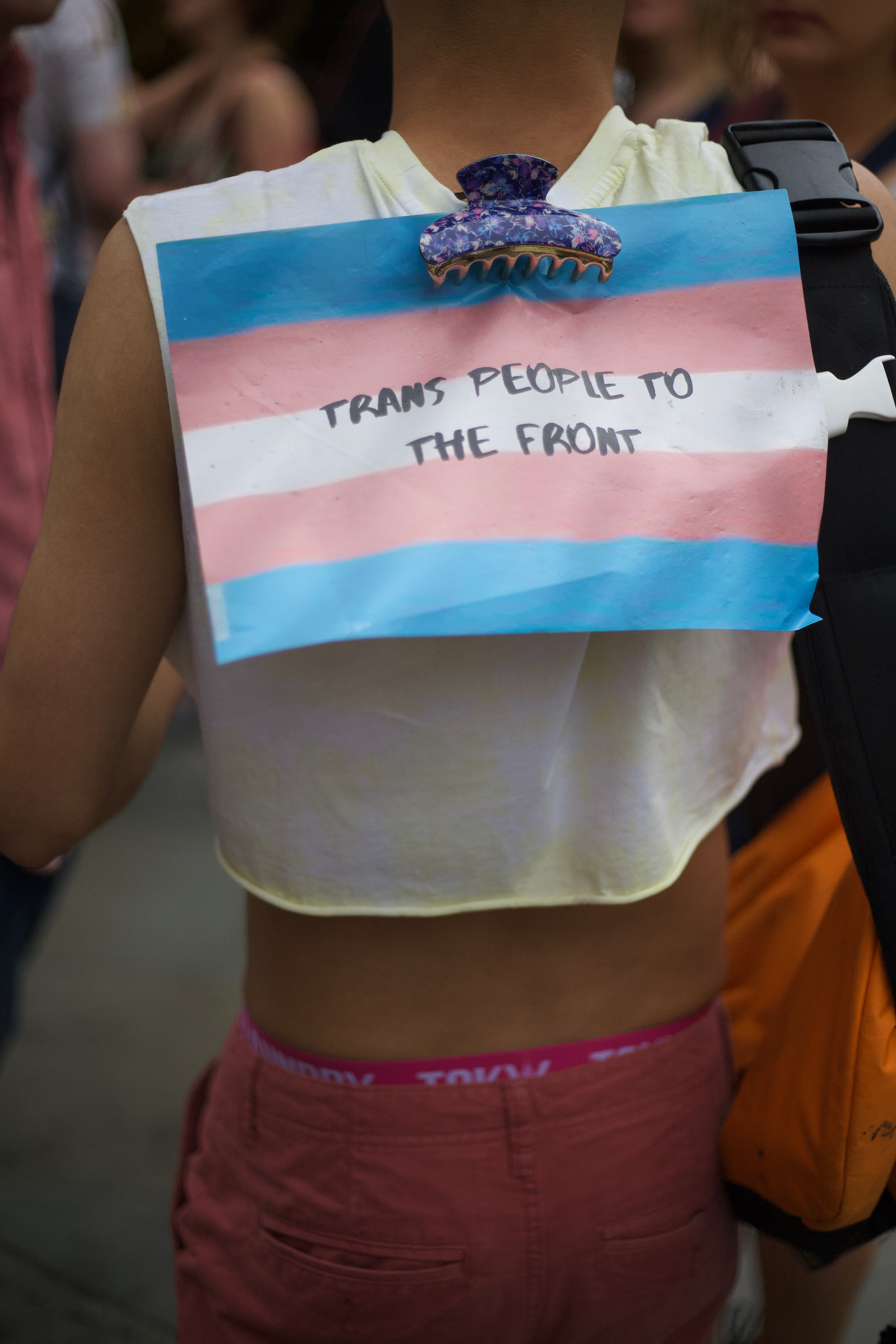
The Politics of Distraction and Censorship
This pattern echoes earlier moral panics surrounding the AIDS epidemic, when politicians and media figures stigmatized HIV/AIDS by associating it with gay men and BIPOC working-class people. The Reagan administration's silence and delayed response to the AIDS epidemic reflected how stigma can shape public policy, as political leaders treated the crisis as a moral issue associated with marginalized communities rather than an urgent public health emergency. Fearmongering and misinformation not only fueled discrimination but also discouraged public discussion about prevention, treatment, and healthcare access. In both cases, appeals to public safety and protecting vulnerable populations can function as mechanisms of social control, obscuring how censorship and stigma often cause further harm to the very communities they claim to protect. Rather than addressing structural problems such as inadequate healthcare, poverty, discrimination, or social isolation, moral panics redirect public attention toward symbolic threats that are easier to sensationalize and politically exploit.
The “Think about the children” fallacy has been noted in social media censorship, where US politicians claim that age verification will shield youth from exposure to pornography and predators, rather than other considerations. However, this also drives hyper-surveillance by sharing ID with companies and apps, making it difficult for online users to remain anonymous. This rhetoric often operates through false empathy, using concerns for children's safety to justify censorship and surveillance instead of addressing young people's genuine needs. By portraying restrictions as protective measures, policymakers appear caring while actually restricting access to information, education, and resources vital for youth's well-being. Social media censorship also includes information being hidden from the public, including sexual education and access to medical care.
The same logic of protection, fear, and social control has reappeared in contemporary anti-trans politics. Much like earlier moral panics, anti-trans legislation is often justified through claims of protecting vulnerable populations while restricting the rights and visibility of marginalized communities. The narrative around anti-trans bills is gender essentialist by borrowing feminist wordings, such as “protect our daughters” or supposed discrimination for cis women and girls. The emphasis on “girls” for cis women and “men” for trans women regarding youth and sports signifies an offensive transphobic depiction of trans people as threatening, especially hyperfocus on only those assigned male at birth in women's sports but not those assigned female at birth in sports of possible harm by cisgender men. These narratives also function as a form of bigotry distraction. Rather than addressing pressing social issues such as healthcare affordability, housing insecurity, poverty, gun violence, or educational inequality, political attention is redirected toward a relatively small and marginalized population portrayed as a cultural threat. By framing trans people as a social problem, policymakers can mobilize fear and outrage while diverting public attention away from broader structural challenges.
Underlying many claims about the “social contagion” of transness is the assumption that people assigned female at birth are especially impressionable, indecisive, or incapable of making informed decisions about their own identities. This creates censorship by portraying information about LGBTQ+ experiences and transition as inherently dangerous to youth. As a result, schools, libraries, educators, healthcare providers, and online platforms face increasing pressure to remove or restrict access to information that contradicts gender-essentialist assumptions.
Without a critical understanding of transness, gender-affirming care, and the social construction of gender, public discourse becomes vulnerable to misinformation and fear. Media outlets weaponize fear, shock, anger, and disgust against marginalized groups to drive profit and political influence, while actively silencing the intellectual discourse needed to humanize trans and detrans individuals by their lived experiences. The consequences extend beyond trans communities. Gender-essentialist policies and the hype of supposed “gender ideology” reinforce rigid expectations for everyone, policing cis masculinity and femininity into unreasonable standards, increasing surveillance of bodies, and contributing to social isolation, mental distress, and exclusion. In this way, anti-trans hype in politics does not merely target trans people; they also cultivate a culture of fear that punishes or silences anyone who falls outside rigid expectations of what it means to be human. To understand the broader impact of this fearmongering, we need to focus on two core questions: what is the actual harm and how is it being defined, and what solutions are being pushed?
[i] Detransition refers to reversing to a pre-transition state or to the gender assigned at birth, which can be medically, legally, and/or socially.
[ii] The term detrans is used to describe individuals who have detransitioned, functioning similarly to how trans refers to individuals who have transitioned.
[iii] Gender dysphoria refers to distress from a person's gender identity that differs from the gender assigned at birth. Not all trans people experience gender dysphoria, and it can vary for each person.
[iv] Cisgender refers to not being transgender, as cis- means “same” just as trans- means “different.”
[v] Transness refers to aspects or qualities relating to being transgender.
[vi] Cisheteropatriarchy describes a socio-political system that advantages cisgender heterosexual men across all levels of society, from individual-level to institution-level.
[vii] From Judith Butler’s “Who’s Afraid of Gender?” Their book focuses on the rise of the anti-gender movement.
[viii] Butler also describes phantasm “as a psychosocial phenomenon, is a site where intimate fears and anxieties become socially organized to incite political passions.”
Kat Fuller is a Ph.D. Student in Sociology at UNLV and Researcher of Far-Right Extremism and Disinformation. Kat's research focuses on right-wing terrorism, disinformation, and radicalization in North America. Kat is a co-founder of the Canadian Institute for Far-Right Studies (CIFRS). Kat's scholarly interests center on the historical and contemporary expressions of far-right politics, with a particular emphasis on their intersections with broader structures of power and their contribution to political polarization, investigating transphobic disinformation disseminated by social movements aligned with the far-right in digital spaces, with a focus on how narratives of detransition are weaponized by anti-gender movements. Through both academic research and public scholarship, Kat aims to challenge harmful ideological narratives, contribute to more informed discourse, and support efforts toward human rights organizing.