Semiotic Bros: Why Tech Billionaire Hype is an Environmental Justice Issue
I spend a lot of time thinking about data centers: the actual, physical buildings consuming water and electricity across the planet. But I also keep thinking about something that seems trivial by comparison: why are the CEOs of all-powerful tech companies so cringe? Elon Musk needs you to think he’s funny. Mark Zuckerberg keeps rebranding himself (remember the MMA phase, or his "masculine energy" push, or the surfboard attempts?). Jeff Bezos joyrides to space. These are men with mind-boggling wealth who own infrastructure that mediates contemporary life, and have shaped policy to serve their interests at the highest levels, and yet they post compulsively, perform what they seem to think is visionary leadership, and wave their hands about building a future that many, as Rebecca Shaw wrote, feel is less the expected horror at their evil than a stranger horror at discovering the people in power are also such losers.
The combination of absolute material domination and social desperation feels nauseating, but this cringe is a constitutive part of tech billionaires’ power, revealing that tech billionaire hype is doing political work that wealth alone cannot. Large swaths of the public are actively grossed out by the push for artificial intelligence in everything all the time, but this push is winning in many narrow institutional rooms where infrastructure and contracts get approved. Call this 'hegemonic hype': a mythmaking that is fragile on the surface (which is why it has to be performed so constantly) but durable in the institutional spaces that approve infrastructure and sign contracts. This is what I mean when I say tech billionaire hype is an environmental justice issue.
The gap between its cultural failure and thus need for constant performance (Palantir chore coats, anyone?) and its institutional success constitutes a sneaky environmental justice issue, because that gap is what allows the material impacts of the loose combination of algorithms referred to as "AI" to proliferate; most visibly, data centers sited over the objections of the communities that will live with them, all over the world.
The mechanism is semiotic. "The cloud" is a sign whose power lies in what it hides; a signifier that is weightless, natural, ephemeral, attached to a signified that is concrete and heavy - water, diesel, concrete, heat. "AI" works the same way, a word vague enough that everyone can project their own meaning onto it and no one can be made to specify which systems, for whose benefit, at what cost. Roland Barthes called this naturalization: the way myth takes a contingent, interested political arrangement and gives it "the simplicity of essences," so that a choice about whose air and water get spent comes to look like a plain fact about technical necessity. What that naturalization buys is consent; not necessarily from a public that may increasingly find the billionaires - and of course, our one trillionaire - ridiculous, but from the officials approving a new building beside an elementary school and working farmland, a building whose water and power draw will land, immediately and locally, on people who may never see its benefits.

Who The Myth Needs to Reach
Theorist, semiotician, and critic Roland Barthes argued that myths operate by transforming political choices into natural necessities; contingent, interested arrangements made to appear as simple facts about the world. Myth "gives them a natural and eternal justification... In passing from history to nature, myth acts economically: it abolishes the complexity of human acts, it gives them the simplicity of essences." (Barthes) When tech industry discourse deploys metaphors like “the cloud” or treats “AI” as an undifferentiated inevitable force, it is doing exactly this mythmaking work. As Tung-Hui Hu has traced, the cloud metaphor specifically emerged to obscure what computation actually requires: concrete buildings, diesel backup generators, massive water consumption, and a supply chain riddled with localized environmental pollution and human rights abuses. The metaphor makes a political choice cloaked in the pretense of neutrality about whose communities bear infrastructure costs sound like a pragmatic statement of technical fact.
But mythmaking requires an audience that receives it as natural. Galanos, in 2018, traced how figures like Stephen Hawking and Elon Musk shaped EU, UK, and US AI policy documents between 2014 and 2018, because their prestige in other domains expanded credibly into AI in the eyes of policymakers who lacked the technical knowledge to evaluate their claims. Parliamentary reports cited these figures as authoritative AI sources, reproducing their framing without examining their credentials. The myth only has to arrive in the room as the most authoritative voice available, in the absence of anyone better positioned to speak.
This is the mythmaking mechanism the cringe obscures. Tech billionaires are failing to persuade an increasing share of the general public, but not everyone. They have been succeeding in the specific, overlapping spaces where decisions about infrastructure get made, like economic development offices and federal AI infrastructure policy. Their semiotic work - social media platitudes, warnings of apocalypse and promises of utopia - is addressed to a general public, but is also importantly addressed at decision-makers trying to keep up with the breakneck speed of AI encroachment across all aspects of society.
Antonio Gramsci theorized hegemony as rule through manufactured consent, with dominant groups making their particular interests appear as everyone’s common sense. Tech billionaires are not necessarily achieving this broad cultural hegemony, but hegemony does not require everyone’s consent - only the consent of those positioned to make particular decisions. The myths are functioning as targeted hegemony: cringe to many observers, and pragmatic common sense to the institutional actors who need to believe that approving as many data centers as fast as possible with no real plan to meet their power demand is sound economic stewardship.
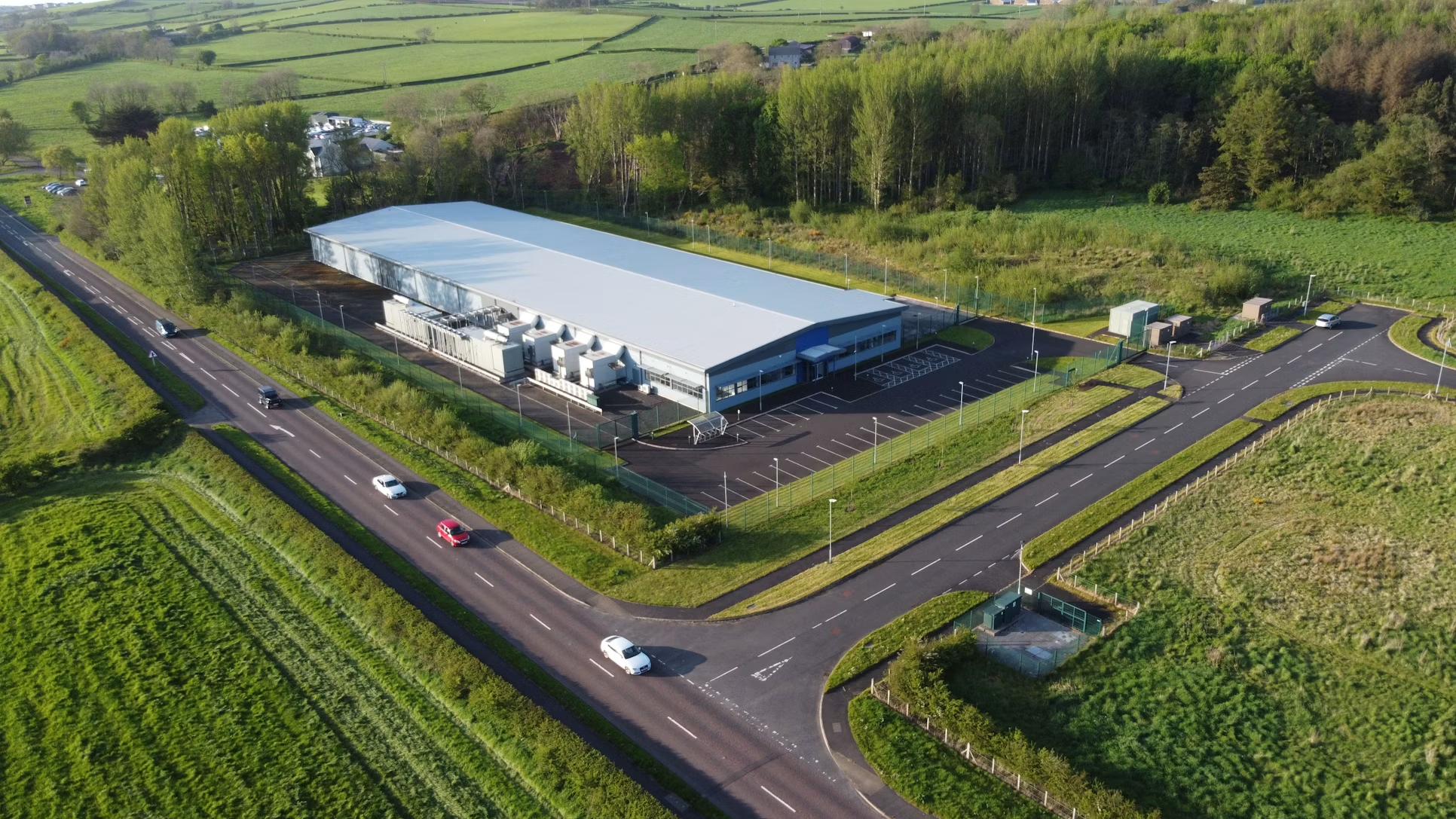
Vagueblogging on Main: The Semiotics of The Cloud and AI
The notion of "the cloud" hides infrastructure behind a weightless signifier (the rebrand Hu traced, by which tech companies lifted their physical facilities up out of any specific geography), and "AI" does something subtler, hiding specificity itself. The acronym is vague by design and “AI” performs strategic ambiguity at scale. What algorithms are we talking about when we say “AI”? What modality - generative AI, or random forest models? Large language model training or route optimization? For whose benefit and to what end? Communication scholars such as Eric Eisenberg use the term “strategic ambiguity” to describe how vague language allows different stakeholders to project different meanings, while forestalling often critical scrutiny. If "AI" is just inevitable technological progress, then questioning whether a specific data center serves community needs sounds like opposing the future itself. Decision-makers can't evaluate what remains undefined, so may default to approving what industry and economic development agencies claim is necessary.
This is where Barthes' naturalization helps us see how the billionaires' personal performances across our screens, stages, and headphones convert the contingent project of AI infrastructure expansion into the self-evident forward motion of history, and the discourse they produce gets reproduced by industry and policymakers as common sense. That the performances strike many observers as cringe does not diminish their institutional function; as a myth does not have to be admired to be operative.
Ruha Benjamin's concept of the "New Jim Code", the way racial hierarchies get encoded into technology under the cover of neutral technical necessity, names a sharper edge of the same process. What presents itself as responsible infrastructure planning is a political choice about whose air, whose water, and whose community gets spent, since a data center's purported benefits rarely reach the people living beside it. The semiotic work naturalizes the sacrifice: it makes the choice look like a requirement.
And it shapes where the buildings go. Data centers get sited in communities already carrying disproportionate pollution burdens because decision-makers frame the approvals as economically necessary; "staying competitive," "attracting investment," "building the future" become the cover for overriding what communities already know about their own water stress and health. Meanwhile, billions flow into speculative AI infrastructure rather than the proven, unglamorous work of decarbonization: grid investment, a just transition, adaptation that could help communities face the weather they are already living through. Our climate future has not been pre-written; every fraction of a degree of warming is a political choice. Hegemonic hype makes the buildout - which will, somehow, eventually, maybe, help solve the very crisis it accelerates - appear to decision-makers as the most serious path forward.
Environmental Justice Practice and The Communities That Pay
Communities organizing against a harmful approach to data center buildouts are engaging in counter-hegemonic struggle, and challenging who gets to define what counts as progress, necessary infrastructure, and beneficial development. Movements are asserting counter-epistemologies, and different visions of what technology should serve.
Environmental justice work is fundamentally about these questions, and rightly centers the disproportionate siting of industrial hazards in communities of color, a pattern Robert Bullard documented beginning with his foundational work Dumping in Dixie, showing it reflects the systematic expectation of reduced political resistance. And there are documented instances of data center development following this pattern, such as the xAI site in Memphis, sited near a community and spewing air pollution.
Pew Research found that 67% of planned US data centers are headed to rural America. JLL's most recent data center report found that 64% of capacity under construction is now in what the industry calls "frontier markets", like West Texas, Tennessee, Wisconsin, Ohio - predominantly white, low-income, and politically marginal communities. These sites share produced political marginality: the systematic expectation of reduced resistance. What produces that marginality differs by place. In Memphis it runs through race; in Richland Parish, through rural class and isolation; in Querétaro, through national position and the Global-South location. This is why the racial analysis and the class analysis do not cancel each other out. Ruha Benjamin's "New Jim Code" names how technical necessity can encode racial hierarchy; the frontier-market pattern names how it can encode class and regional disposability. They are a similar naturalizing move: a political choice about whose objection can be safely overridden, dressed as a technical fact running along whichever axis of marginality is locally available.
Meta's Hyperion project in Richland Parish, Louisiana further illustrates the structure. Richland Parish is a majority-white rural county with a median household income below $35,000. Meta is building a facility comparable in footprint to Manhattan, powered by ten new natural gas plants, consuming at full capacity roughly a fifth of Louisiana's total electricity. It sits between a 200-student elementary school and working farmland. The economic development promises do not survive contact with the arithmetic. And as critics have noted, Louisiana's Cancer Alley corridor offers a documented precedent for what happens when heavy industrial infrastructure is sited in low-income communities with limited political leverage: elevated cancer rates, respiratory disease, the systematic failure of regulatory frameworks to respond to cumulative industrial burden.
A predictable counter-argument surfaces here: won't AI help solve climate change? This claim itself exemplifies mythmaking, transforming speculative future benefits into justification for present harms. Some computational techniques loosely grouped under "AI" can optimize energy systems or model climate dynamics. But the current buildout prioritizes commercial applications, not the deployment of proven climate solutions. The energy-intensive training of large language models actively undermines decarbonization. And the communities bearing the costs of new gas plants built to power data centers are not the ones who will benefit if those models ever deliver on their climate promises. The myth that AI might eventually solve climate change transforms that choice into a hedge, justifying present extraction with speculative future redemption. Even where the semiotic performances fail, the podcast appearances and sponsorships are labor spent making extraction look like inevitability, and the cost of that decision lands on the community living beside the gas plant, not on the people laughing online.
Mythmaking saturates the discourse decision-makers operate within. Tech industry reports and mainstream narratives frame AI as inevitable and data centers as necessary. Whether regulators absorb these frameworks credulously or deploy them cynically is difficult to determine and perhaps less important than the outcome: projects get approved over community opposition. But movements are contesting this in many places, blocking projects, winning stronger regulations, forcing meaningful environmental review that goes beyond procedural compliance to actually assess cumulative impacts and alternatives, asserting community authority over development decisions. The work is hard because it requires dismantling myths in spaces where those myths function as common sense, but it's happening.
Unfortunately, tech billionaires often do get to decide what gets built materially. Affordable housing? No. Rapid transit? No. Hundreds of data centers? Yes. But they don't control what people imagine or desire. Communities know what thriving futures look like, and they articulate them constantly in organizing spaces, by planning alternatives, and through building mutual aid networks. The cringe reveals that people see through the myths, but the material power lets extraction proceed anyways.
Myth Fragility As Strategic Opportunity
The constant posting, the failed rebrands, the transparently anxious bids for relevance are not incidental. They are evidence of instability. Barthes observed that naturalized myths appear to mean something by themselves, they require no reinforcement. If the narratives were truly naturalized, the billionaires would not need to keep producing them. The labor shows. And labor that shows is labor that can be interrupted.
Galanos makes a parallel observation: the hype cycle requires constant renewal, and genuine AI experts are largely absent from the policy spaces where the hype circulates. This absence is not neutral. It means the discourse is being shaped by expanding experts whose statements are reproduced by policymakers precisely because they are famous enough to seem authoritative and vague enough to serve multiple purposes. When communities or advocates introduce specific technical expertise into planning proceedings - concrete water consumption numbers, actual emissions projections, documented cumulative pollution burdens - they are not just providing information. They are disrupting the epistemic structure that allows expanding expertise to function as common sense.
Environmental justice organizing has always been about contesting who gets to define what counts as progress, necessary infrastructure, and beneficial development. The current moment adds a specific task: contesting mythmaking in the institutional spaces where it functions as common sense, even as it fails everywhere else. The cringe tells us the myths are fragile. The question is how to make that fragility matter where it counts.
Refusal and Possibility: An Agenda for the Future
Environmental justice organizing has always understood that fights over development are fights over what kind of world we want to live in, what futures we want to co-create. As digital infrastructure's physical impacts become more visible and contentious, contesting mythmaking becomes crucial organizing work.
This means challenging myths where they operate: in planning proceedings, regulatory hearings, economic development discourse. Concretely, this looks like: showing up to public comment periods with data on actual water consumption and asking regulators to reconcile it with sustainability claims; demanding that approvals specify which AI applications require this facility and who benefits; submitting community health data and environmental monitoring as legitimate evidence alongside industry projections; making visible that approvals are political choices about whose wellbeing matters, not technical necessities. Every tactic below is a way of forcing specificity into a process that depends on vagueness to function.
Name the signs, not just the harms. When industry representatives use "the cloud," "AI infrastructure," or "smart city" in planning proceedings, ask them to define their terms on the record. What specific applications require this facility? Which techniques? What is the energy consumption model? Vagueness is doing political work; specificity dismantles it. Every question that requires a concrete answer is a myth-disruption.
Counter expanding expertise with actual expertise. Galanos's research shows that policymakers reproduce prestigious figures' statements because credentialed alternatives are absent from the room. Bring them in. Grumpy environmental engineers, public health researchers, hydrologists, agricultural economists, and climate scientists can translate industry projections into community terms. A data center's water consumption stated in gallons per day against a municipality's existing supply stress is a different document than "the cloud needs infrastructure." University environmental justice centers and organizations like the Environmental Data and Governance Initiative often have technical staff available for exactly this kind of support.
Use the regulatory record against itself. When industry submits sustainability claims in planning documents, file public records requests for the underlying data: water consumption projections, emissions modeling, energy source disclosures, backup generator test schedules, tax incentive arrangements. Ask regulators to reconcile industry sustainability narratives with their own environmental review data. Make the gap between myth and documentation visible and formal.
Demand specificity about beneficiaries. Require that approvals name which AI applications will run in the proposed facility and who benefits from them. "AI infrastructure" is not an answer. If the facility supports advertising optimization for a single tech company, that is a specific political choice about whose community bears the cost of one company's revenue. Name it as such in public comment. Make regulators respond to the named choice rather than the naturalized necessity.
Test the economic development arithmetic. When promised jobs and tax revenue are offered as justification, ask for specifics: how many permanent jobs, at what wages, for residents of this community specifically? What is the net tax impact after incentives and infrastructure subsidies? What is the opportunity cost — in water, energy, land, and foregone development — of hosting this facility? In Querétaro, Microsoft projected 300,000 jobs from its investment; one data center employed 64 people. In Louisiana, 500 permanent jobs are promised for a facility the size of Manhattan. The promises depend on the same vagueness as the technical claims. Specificity is the counter.
Submit community knowledge as formal evidence. Health monitoring data, water quality records, documented pollution burdens, cumulative impact assessments, and agricultural land use data submitted by community members carry legal weight in environmental review processes. They also reframe what counts as relevant knowledge in the proceeding, which is itself a form of myth-disruption.
Connect to the wider resistance. Data center opposition is organized and active in many places simultaneously, from rural parts of the United States to entire states in countries across the world, like Brazil and Greece. These movements share tactics, evidence, and legal strategies. The MediaJustice Toolkit, the NAACP playbook, and many more resources offer great places to start.
What some call the "broligarchy", the term journalist Carole Cadwalladr popularized, needs constant mythmaking because their position is weak ideologically even while strong materially. They need decision-makers to believe approving extraction over community objections is justified, necessary, aligned with progress. Those are myths, and myths can be dismantled through persistent refusal and concrete alternatives.
Tech billionaires can post all they want. They can try to colonize Mars while Earth burns. But they can't make communities consent to bearing the burdens of their infrastructure. They can't make us forget that technology could mean something else rooted in care for the planet and each other. And in that refusal, other futures - great, thriving futures built by and for communities rather than extraction - become possible.

Sanjana Paul is an engineer, environmental justice researcher, and systems thinker working at the intersection of infrastructure, climate, and technology. She is the co-founder and executive director of Rooted Futures Lab, a systems change organization centering environmental justice in technology, and a PhD student at MIT, where her research focuses on renewable energy, energy justice, and the electric grid. Her work has ranged from atmospheric science software engineering at NASA to passing decarbonization policy at the local level. She holds a BS in electrical engineering and physics from VCU, and a Master’s in Environmental Policy and Planning from MIT.