Oh, the concerned “AI” bros
For days, the debate has been raging again about whether “AI” is too dangerous. The warnings are not new and the industry has other interests, comments tante.
We have been reading a lot recently about the concerned “AI” bros ([Editor’s note:]tante puts “AI” in quotation marks because the term is misleading, is associated with vague expectations, and has nothing to do with real intelligence): Dario Amodei and Sam Altman both talk about slowing down the development of “frontier AI”, and even Elon Musk agrees:
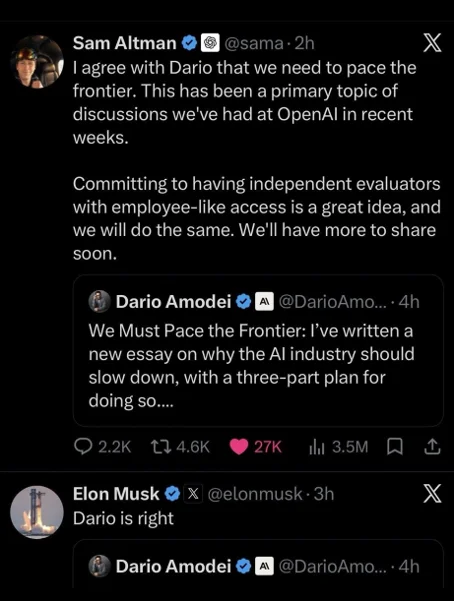
An unholy alliance that should give pause for thought, especially since the three gentlemen involved deeply despise each other. Is the concern of the “AI” bros for the future so great that it overshadows all conflicts? Is the current case of Jacob Coxon, who quit his job at Anthropic out of fear that “‘AI’ could wipe us all out,” also an expression of this fear of real consequences? Coxon even appears on US television to emphasize that humans have few countermeasures left because “the AI” simply spreads like a virus to other machines if one wanted to shut it down. Is this a real scenario?
Of course not. And the reporting is unfortunately really annoyingly bad.
Warnings years ago
First, it is of course important to know that Anthropic split off from OpenAI because OpenAI was not cult-like enough for the splitting individuals: Although Amodei officially describes it as different ideas about the safety of “AI” and the question of how to increase the capabilities of “AI”, the real motives seem to shine through even in the statement. Anthropic was founded by people from the Effective Altruism (EA) bubble, who truly believe that LLMs are simultaneously an “existential Risk” (i.e., a risk to the survival of humanity, here was a breaking point with OpenAI’s view) and a new god that emerges if one only applies the “Scaling Laws”, i.e., building ever larger systems. This system should then largely be handed over control so that it can solve almost all of humanity’s problems.
This way of thinking had (and has) a certain influence at OpenAI too, but a more pragmatic perspective still prevails there: In the end, they hope to find a business before Sam Altman runs out of stories. Anthropic, on the other hand, is much more “on a mission.” So the agreement is unusual even from this perspective, requiring a closer look. Anthropic, in particular, is in a dilemma here, which has always been resolved in favor of more development.
Now we have all played the story of “our magical AI models are too dangerous/powerful to release” several times. We all remember when even GPT-2 was too powerful for a public release in 2019. A model that no one is interested in anymore today because it is too bad for any usual use case.
But the slash is important: The claim of “our model is super dangerous” is primarily the claim that a model is powerful. It is an advertising message to keep the hype around LLMs going.
Because where does the industry stand right now?
Anthropic and OpenAI want to go public soon, partly because it is becoming increasingly difficult for them to get other funding for their highly loss-making companies, and the large ETFs and pension funds would be very welcome.
Although Anthropic has claimed to be profitable for several months, no one has seen real numbers yet. None of the “AI” companies keep accounts according to accepted criteria. Instead, they have established the key figure, ARR (Annualized Recurring Revenue). This means: The companies pick out 4 good weeks, multiply them by 13, and claim that this describes the year. A creative form of economic calculation, to say the least.
In addition, Anthropic has recently received highly subsidized compute from Elon Musk so that Musk’s Colossus datacenter – that is, the one in Memphis with the illegal methane generators – is utilized a little more. It is not surprising that Anthropic can find a time window in this way in which the numbers do not look disastrous. By offering Anthropic compute resources at extremely favorable (probably not cost-covering) conditions, Elon Musk is thus taking over at least part of Anthropic’s losses.
For the IPOs, the “AI” companies currently need every positive message to overcome the general discontent about “AI” and data centers: “AI” is incredibly unpopular (in a poll in March in the US, even less popular than Donald Trump and ICE). It takes a miracle to ensure that the IPO goes as planned. Because that means it has to be the biggest IPO of all time; otherwise, it would be considered a massive weakness. SpaceX’s IPO, where the stock plummeted after a short run, has also made investors more cautious.
The “AI” companies therefore need press. Press that ensures that people believe that “AI” – i.e., the systems that, after an investment and a PR campaign the likes of which no technology in human history has ever received, still do not function reliably – represents “the future.” And in that context, it is of course good to present oneself as “cautious” and “prudent” to counteract the vibe the industry has conveyed so far.
But there is an even more direct economic argument:
The flattening performance curve
“AI” models are getting better and better, according to some benchmarks. But in practice, many of these improvements primarily manifest in higher costs: the ever-larger models, which increasingly call themselves in circles (“reasoning”), consume more and more resources for largely similar performance. Because every marginal improvement of the models comes with exponential costs, not only in inference (i.e., the use of the models), but of course also in training: training ever larger models causes development costs to rise ever higher – even if specialized chips bring certain efficiency gains.
The “AI” companies therefore have exploding costs for new versions of a product that do not feel massively better for users but are significantly pricier to operate. This is a problem in an already loss-making industry where more and more customers are increasingly restricting their “AI” spending. The market to be shared is no longer expanding as bet on but shows signs of possibly even shrinking. At the same time, the cost of one’s own product continues to increase. And none of the “AI” labs currently have truly new ideas in the pipeline that could enable real leaps in quality.
In this situation, the coordinated narrative of “we would rather not train new models for a while because they are too dangerous” is naturally useful: One can save the expensive development costs for a while to make one’s own numbers look a little better for the IPO. At the same time, one hopes that Nvidia or someone else will find some efficiency gains that might make the current plateau economically viable (the good old “thoughts and prayers” business strategy).
Playing for time
If it were possible to establish a regulatory framework through a large-scale PR campaign that “forces” this pause and could slow down other players in the market, it would be a double win. Chinese providers in particular would not necessarily go along but would be excluded from the US market, giving US Frontier Labs even more time. Especially time to find new, solvent customers like the military, intelligence agencies, and the police.
So it is existential for the “AI” labs to establish this “pause” as important – without referring to the facts: Without the pause, the money will run out even faster and the bubble will burst.
So they distract the public with seemingly plausible horror stories: “The AI just jumps to other machines if we try to shut it down!” Sure. “AI” systems that run only on specialized hardware in huge data centers that consume as much electricity as a small town secretly jump into my laptop and control the world from there. What an absurd story.
The narrative of “AI is so powerful and dangerous” has become the 5th season: Once a year, “AI” bros come and retell their favorite sci-fi movies, and we nod and have talk shows about it. Like the suckers we are.
If one were to take the warnings of the “AI” bros seriously, one would have to lock them all up. Let’s play through an analogy: I start a company that researches chemical reactors. My product synthesizes whatever you wish for, with a certain probability. It can also produce mustard gas; one doesn’t know exactly. I distribute these reactors all over the city because decentralized chemical reactors are the future. But my PR is mainly about how the reactors might produce mustard gas and terrorists will naturally use it. My start-up would be closed within hours, and I would be behind bars. Not unjustly.
Don’t believe everything anymore
But somehow, everyone also realizes that the difference between my analogy and the “AI” stuff is that the “AI” story is largely humbug. Of course, “AI” is not without danger. “AI” use has a negative impact on people’s abilities and skill development (“deskilling”), thereby taking away their agency and self-determination, forcing them into dependence, and destroying the environment through its massive resource requirements. Unleashing “AI” systems onto the internet and real infrastructures can indeed be dangerous – not because the systems are so smart, but because they operate stochastically without understanding risks, so that a lot of damage can potentially occur. However, “AI” systems do not operate like secret agents but rather like a forest fire.
But as long as no one connects ChatGPT and the like directly to rocket launchers, “AI” systems will not destroy the world. Because LLMs do nothing without prompts, and if someone connects “AI” to dangerous systems, that person is the problem, not the LLM. If “the AI,” for example, hacks systems, there was always a human who (at least indirectly) prompted or triggered it. This can definitely happen, but has nothing to do with “autonomous AI.” And for such attacks, you don’t need particularly fancy models; the previous generation was already sufficient.
We really need to stop buying into the tech bros' stories and taking them seriously. They are not reliable communication partners. Instead, we must question these stories again and again. Otherwise, we will end up like Elon Musk with Anthropic’s losses in our hands and without water because the datacenter needs it.
/tante aka Jürgen Geuter is a sociotechnologist, writer and speaker working on tech and its social impact. Communist. Feminist. Antifascist. Luddite. Original version of the test in German, accessible under: https://tante.cc/2026/09/14/der-besorgte-ki-bro/
Hypestudies thank for the permission to republish in English.